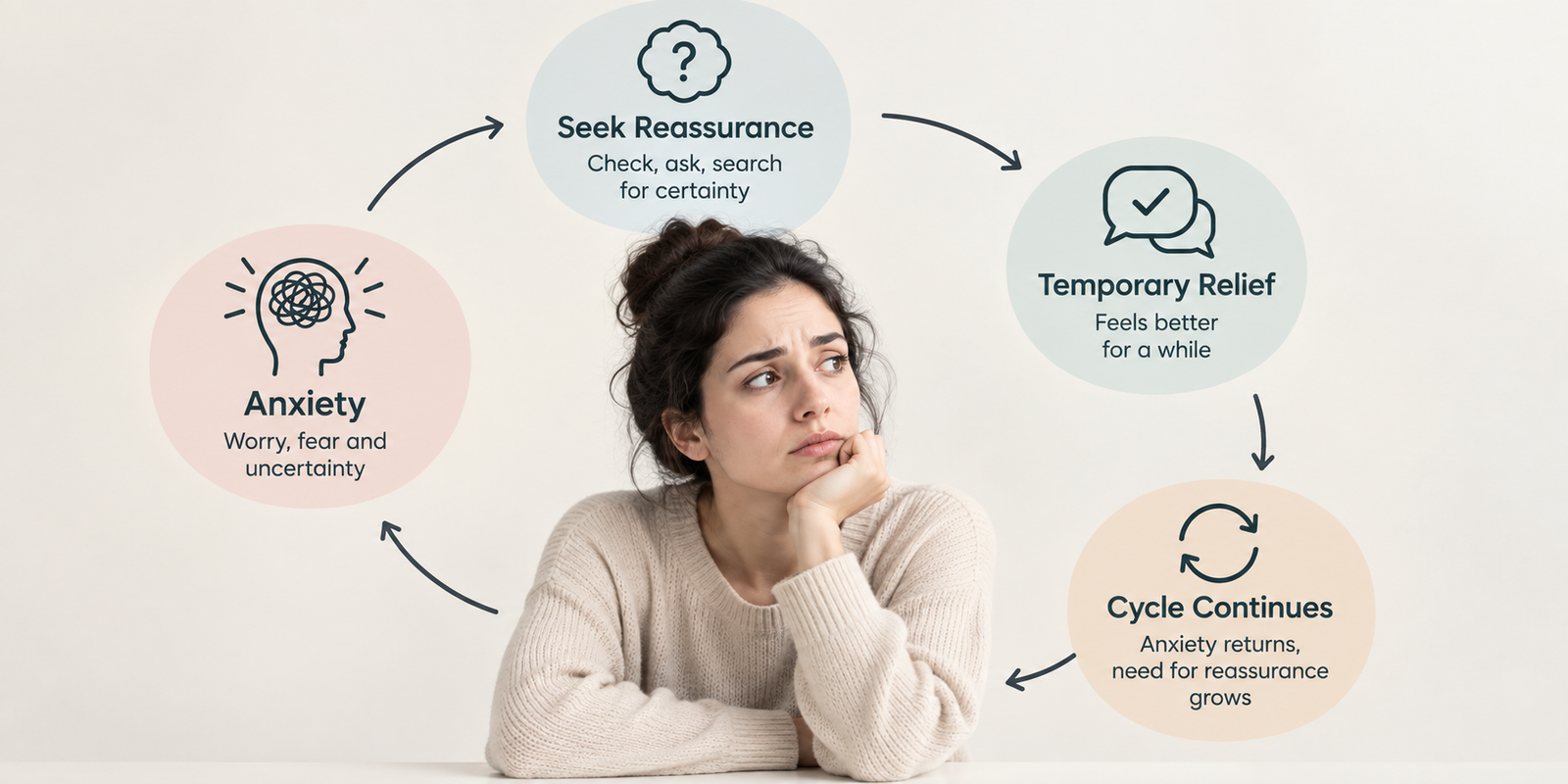
What Is the Anxiety–Reassurance Cycle?
When anxiety becomes overwhelming, it is natural to look for reassurance.
You might ask a friend, “Do you think everything is going to be okay?”
You might search your symptoms online, repeatedly check something, ask someone the same question several times, or seek confirmation from a doctor, partner, family member, or coworker.
For a moment, the answer may make you feel better.
But then another doubt appears.
“What if they were wrong?”
So you ask again.
This creates what can be called the anxiety–reassurance cycle:
Anxiety → uncertainty → reassurance seeking → temporary relief → new doubt → more anxiety → more reassurance seeking
Reassurance itself is not necessarily unhealthy. Asking for support is a normal part of life. The problem develops when reassurance becomes a repeated strategy for trying to eliminate every uncomfortable doubt or possibility.
Clinical literature on cognitive-behavioral approaches identifies reassurance seeking, avoidance, safety behaviors, and intolerance of uncertainty as factors that can maintain anxiety.
Why Does Anxiety Make You Want Certainty?
Anxiety is closely connected with the brain's response to potential threats.
Importantly, a threat does not have to be immediate or certain for anxiety to activate. Research from the National Institute of Mental Health describes anxiety as a response system involved in situations where potential harm is ambiguous, distant, or uncertain.
That helps explain why anxious thinking often sounds like:
“What if something goes wrong?”
“What if I missed something?”
“What if they are upset with me?”
“What if this symptom means something serious?”
“What if I make the wrong decision?”
“What if I cannot handle it?”
The brain wants an answer that removes the uncertainty.
Unfortunately, life rarely provides 100% certainty.
This mismatch can keep anxiety going.
How Reassurance Provides Temporary Relief
Imagine someone notices an unusual physical sensation.
They become concerned.
They search online and find information suggesting that the symptom can sometimes be harmless.
Their anxiety decreases.
For a short time, they feel safe.
But later, they notice another sensation.
The original reassurance suddenly does not feel sufficient.
They search again.
The process repeats.
This can teach the brain an unintended lesson:
“When I feel uncertain, I need reassurance before I can feel safe.”
Over time, the person may become increasingly dependent on checking, researching, questioning, or seeking confirmation.
Research has found a relationship between anxiety, intolerance of uncertainty, and reassurance-seeking behavior, with daily reassurance seeking fluctuating alongside anxiety in one observational study.
Reassurance vs. Healthy Support: What's the Difference?
Not every request for reassurance is problematic.
Talking to someone you trust when you're worried can be healthy.
For example:
“I've had a difficult day. Can we talk?”
That's different from repeatedly asking:
“Are you absolutely sure everything is okay?”
Then asking again five minutes later because the first answer doesn't feel convincing.
Healthy support usually:
helps you process emotions
provides perspective
encourages constructive action
does not require endless confirmation
allows some uncertainty to remain
Anxiety-driven reassurance seeking may:
happen repeatedly
provide relief only briefly
increase checking or questioning
focus on achieving complete certainty
make uncertainty feel increasingly intolerable
The distinction is not always obvious, and reassurance seeking can occur across different anxiety presentations.
Why Constant Reassurance Can Backfire
The biggest problem is that reassurance may reduce anxiety without teaching the brain that uncertainty can be tolerated.
Suppose you are worried about making a mistake.
You ask three people whether your decision is correct.
Everyone says yes.
You feel better.
But you may not learn:
“I can make a decision even when I cannot know the outcome with certainty.”
Instead, you may learn:
“I need three people to tell me I'm right before I can move forward.”
The next decision may therefore create the same problem.
This is why cognitive-behavioral approaches often target reassurance seeking and other safety behaviors rather than simply trying to provide endless reassurance.
The Connection Between Anxiety and Intolerance of Uncertainty
One important concept behind reassurance seeking is intolerance of uncertainty.
People naturally dislike uncertainty to some degree. But when uncertainty becomes especially difficult to tolerate, the mind may repeatedly attempt to eliminate it.
For someone with significant anxiety, “I don't know” can feel unacceptable.
The mind therefore tries to turn:
“I don't know what will happen.”
into:
“I need to know exactly what will happen.”
That can fuel:
Research has identified intolerance of uncertainty as an important concept in generalized anxiety disorder and other emotional disorders.
Health Anxiety and Reassurance Seeking
Health concerns can make this cycle particularly noticeable.
Someone may notice a headache, heartbeat, stomach sensation, muscle twitch, or other physical symptom and immediately wonder whether it indicates a serious illness.
They might:
Search the symptom online.
Ask someone whether it is dangerous.
Check their body repeatedly.
Search again when the reassurance wears off.
Make another appointment or request additional confirmation.
Temporarily feel better.
Become concerned about another symptom.
This does not mean that physical symptoms should be ignored.
New, severe, persistent, or concerning symptoms should be appropriately evaluated by a healthcare professional.
The issue is the repetitive search for absolute certainty after reasonable evaluation has already occurred.
NICE guidance specifically notes that repeated reassurance seeking about physical or bodily symptoms can occur in people with GAD and should be considered as part of assessment.
Reassurance Seeking in Relationships
The cycle can also appear in relationships.
Someone with anxiety might repeatedly ask:
“Are you mad at me?”
“Do you still like me?”
“Are you sure everything is okay?”
“Did I say something wrong?”
“Are you going to leave me?”
The other person provides reassurance.
The anxiety disappears temporarily.
Then a delayed text message or different tone of voice creates another uncertainty.
The questions return.
This can become exhausting for both people.
The goal is not to stop communicating with people you trust. Instead, healthier coping involves learning to distinguish genuine communication needs from anxiety-driven attempts to eliminate uncertainty.
How to Break the Anxiety–Reassurance Cycle
Breaking the cycle does not mean forcing yourself to ignore every concern.
Instead, it means gradually learning that anxiety and uncertainty can exist without immediately responding with checking or reassurance.
1. Notice the urge
Start by identifying the moment you want reassurance.
Ask yourself:
“Am I looking for useful information, or am I trying to make uncertainty disappear?”
That small distinction can be powerful.
2. Delay the reassurance
You don't necessarily have to eliminate reassurance seeking immediately.
Try delaying it.
For example, if you normally ask someone for confirmation immediately, wait 10 or 15 minutes.
During that period, notice what happens to the anxiety.
You may discover that the intensity changes without receiving a new answer.
3. Accept that uncertainty exists
Instead of trying to prove that everything will be okay, practice a different response:
“I don't know exactly what will happen, but I can handle not knowing right now.”
This is not pessimism.
It is learning to tolerate uncertainty.
4. Reduce repetitive checking
If you repeatedly search symptoms, reread messages, check emails, or ask the same question, gradually reduce the behavior.
The objective is not perfection.
It is building confidence that you can function without checking every possibility.
5. Challenge anxious thinking
CBT can help people identify automatic thoughts, examine whether they are accurate or helpful, and change behaviors that maintain anxiety. NIMH identifies CBT as a commonly used, research-supported treatment for generalized anxiety disorder.
6. Focus on what you can control
Ask:
“What can I actually do about this situation?”
If there is a practical action, take it.
If there isn't, repeatedly thinking about the possibility may not provide additional protection.
Can Medication Help With Anxiety?
Medication can be part of anxiety treatment for some people, but it should be selected with a healthcare professional based on the person's symptoms, diagnosis, other medications, medical history, and preferences.
For generalized anxiety disorder, treatment may involve psychotherapy, medication, or both. SSRIs are commonly used, and other medications may be considered depending on the circumstances.
Medication does not necessarily address every behavioral pattern associated with reassurance seeking. For many people, learning new ways to respond to uncertainty is an important part of psychological treatment.
NICE recommends psychological interventions such as CBT for people with GAD who require higher-intensity treatment, with medication also considered according to clinical circumstances and preference.
When Should You Get Professional Help?
Consider talking with a healthcare professional if anxiety:
interferes with work or school
affects relationships
makes decision-making extremely difficult
causes persistent physical symptoms
leads to repeated checking or reassurance seeking
interferes with sleep
feels difficult to control
causes significant distress
Generalized anxiety disorder involves persistent, difficult-to-control worry that affects everyday life; professional assessment can help distinguish an anxiety disorder from ordinary periods of stress or worry.
If anxiety is accompanied by thoughts of self-harm or suicide, seek urgent professional or emergency support.
Frequently Asked Questions
Is reassurance bad for anxiety?
No. Healthy reassurance and emotional support can be helpful. The concern is repetitive reassurance seeking that provides only temporary relief and becomes necessary to feel safe.
Why does reassurance only work temporarily?
Reassurance can reduce anxiety in the moment without necessarily changing the underlying fear of uncertainty. When another doubt appears, the person may seek reassurance again.
How do I stop seeking reassurance?
Start by noticing the urge, delaying the response, reducing repetitive checking, and practicing tolerance of uncertainty. CBT can be particularly useful for changing anxiety-related thought and behavior patterns.
Is reassurance seeking a symptom of anxiety?
It can be. Reassurance seeking may occur as a maintaining behavior in anxiety disorders, particularly when it becomes repetitive and difficult to resist.
Can CBT help with reassurance seeking?
Yes. CBT can address anxious thoughts, avoidance, safety behaviors, and reassurance-seeking patterns. It is a commonly used treatment for generalized anxiety disorder.
Final Thoughts
The anxiety–reassurance cycle can be difficult to recognize because reassurance feels helpful at first.
The problem is not asking for support.
The problem is when your brain starts believing that you must obtain certainty before you can feel safe, make decisions, or continue with your day.
Breaking that pattern involves gradually developing a different skill: tolerating uncertainty without automatically responding to every doubt.
With appropriate support, CBT, lifestyle changes, and medication when clinically appropriate, anxiety can be managed effectively. Treatment should be individualized rather than based on a single strategy or medication.